
Lifecycle Email for Startups With Under 1,000 Users
Lifecycle email for startups with under 1,000 users is not about automation complexity. It is about learning what makes people stay before you scale.
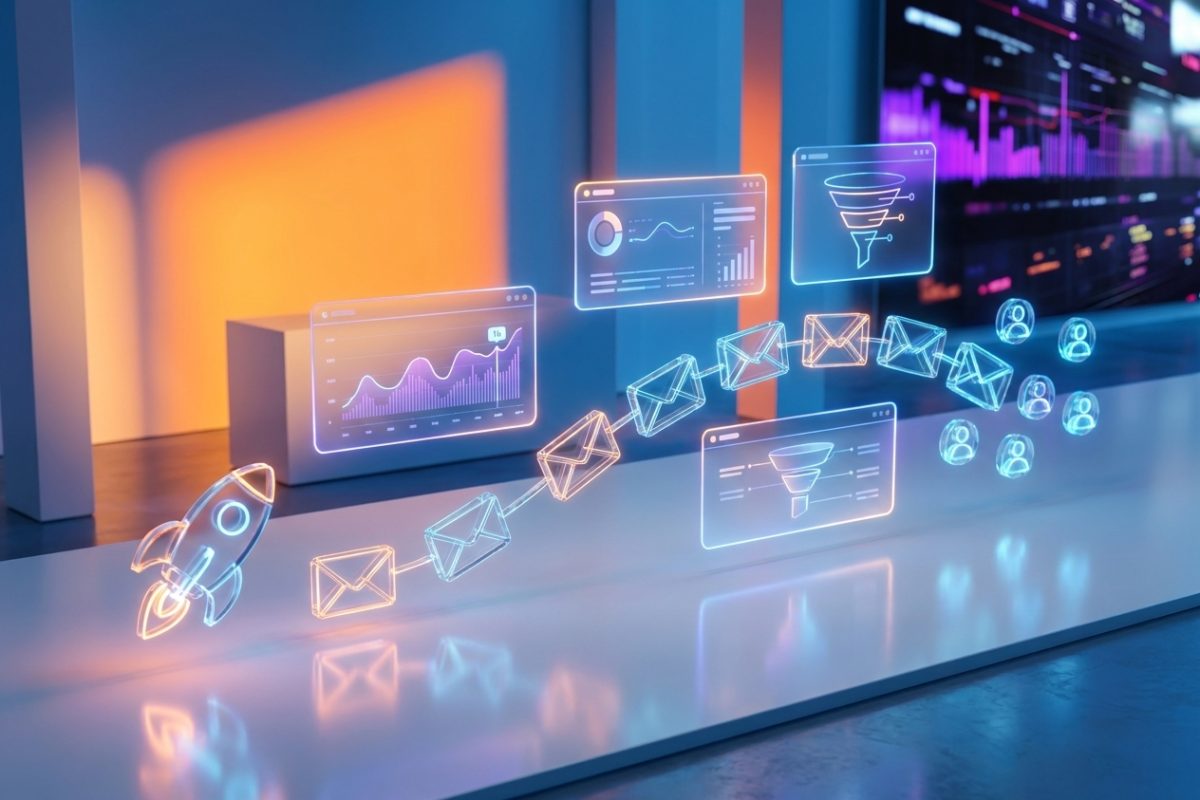
Most lifecycle email advice assumes you have tens of thousands of subscribers, a dedicated email team, and months of behavioral data to segment against. You have none of that. With under 1,000 users, lifecycle email is not a retention machine yet. It is a research instrument: a way to learn which messages make people come back, pay, or refer, before you spend money acquiring the next thousand.
Get a lifecycle email plan built for your stage and your actual user count.
Why Small Lists Are a Strategic Advantage
A 500-person list that came through a beta signup or a Product Hunt launch has something a 50,000-person list does not: a high proportion of people who actually chose to be there. Open rates in the 50-70% range are common at this stage. Click rates above 10% are not unusual. These numbers will never be this good again, so the emails you send right now generate unusually clean signal about what resonates.
The mistake founders make is treating email like a channel to “turn on later.” They wait until they have a bigger list, a marketing hire, or a proper ESP migration. Meanwhile, the users who signed up earliest, the ones most likely to become advocates, receive nothing. Or worse, they receive a single welcome email and silence. That silence is itself a message: this product does not have its act together.
At under 1,000 users, every email you send is also a micro-survey. The reply rate alone will tell you more about product-market fit than most analytics dashboards.
The Only Flows You Need Right Now
Enterprise lifecycle programs might have dozens of flows: onboarding, activation, re-engagement, winback, cross-sell, upsell, referral, NPS, sunset. At your stage, you need three. Maybe four. Here is the order in which to build them.
That is it. Four flows, perhaps eight to ten total emails. You can build this in an afternoon with any modern ESP.
Welcome and Activation (Emails 1-3):
The first email goes out within five minutes of signup. It does one thing: gets the user to complete the single action that correlates most with retention. For a SaaS product, that might be creating a first project. For a marketplace, it might be completing a profile. Do not explain your company’s mission. Do not link to your blog. Get them to the activation moment. Emails two and three, spaced at 24 and 72 hours, nudge users who have not completed that action and offer a different angle on why it matters.
Value Delivery (Ongoing, Weekly or Biweekly):
Once a user has activated, send them something useful on a regular cadence. This is not a newsletter. It is a short email that either shows them a feature they have not tried, shares a use case from another user (ask permission first), or gives them a concrete tip tied to what they have already done in the product. The goal is to deepen usage, not to broadcast.
Feedback Request (Triggered, Day 7-14):
After a user has had enough time to form an opinion, send a plain-text email from the founder asking one question. Not a survey link. Not an NPS widget. A single question in the body of the email: "What is one thing you expected this product to do that it does not?" The replies to this email are worth more than months of analytics at your stage.
Re-engagement (Triggered by Inactivity):
If a user has not logged in for 14 days (adjust this threshold to your product’s natural usage frequency), send one email. Not three. Not a drip sequence. One email that says, plainly, what has changed or improved since they last visited. If nothing has changed, do not send it.
Choosing a Tool Without Overbuilding
Founders with under 1,000 users routinely sign up for HubSpot or Marketo and then use 3% of the platform. At this stage, you need three capabilities: time-based triggers, event-based triggers (user did X in the product), and the ability to reply to emails and have those replies land in a real inbox.
Mailchimp handles the first and third but is weak on event-based triggers without workarounds. Customer.io, Loops, and Resend are built for product-triggered email and are designed for small teams. Postmark is excellent if your emails are transactional-adjacent. The right choice depends on whether your activation events live in your product database or in a third-party analytics tool.
Do not spend more than a day choosing. The difference between tools matters far less than the difference between sending and not sending.
What to Measure (and What to Ignore)
Open rates at this scale are noisy. A single user opening an email three times or Apple’s Mail Privacy Protection pre-fetching content can swing your rate by 15 percentage points. Do not optimize around opens.
The metrics that matter at under 1,000 users:
- Reply rate. How many people respond to your founder emails? If fewer than 2% reply to a plain-text question, the question is wrong or the timing is off.
- Activation conversion. Of users who receive your welcome sequence, what percentage completes the activation action? Compare this to users who signed up before you built the sequence.
- Unsubscribe rate per email. A spike on a specific email tells you that email is either irrelevant or badly timed. Fix or remove it.
- Revenue or upgrade correlation. If you have a paid tier, tag users who received each email and compare conversion rates. Even with small numbers, a 2x difference is directional signal.
Do not build dashboards. A spreadsheet updated weekly is faster to maintain and easier to share with a co-founder. Formal reporting infrastructure can come when you have a team to read the reports.
Plain Text, Founder Name, Real Reply Address
Beautifully designed HTML emails with header images and branded footers perform worse than plain text at this stage. This is not a universal truth; it is a stage-specific one. Your users signed up for a product, not a media brand. An email that looks like it came from a person gets read. An email that looks like it came from a marketing department gets archived.
Send from the founder’s name. Use a real reply-to address that someone checks daily. When users reply, respond within hours. These early conversations are not a distraction from building the product. They are growth marketing in its most direct form: learning what your users need and proving that you care enough to listen.
The single highest-ROI email a founder can send is a one-line reply to a user who took the time to write back. That interaction compounds into retention, referrals, and product insight simultaneously.
When to Add Complexity
You do not need segmentation when you have 400 users. You probably do not need it at 800 either. The urge to segment is usually a sign that you are avoiding a harder question: is this email good enough to send to everyone?
Add a segment only when you have clear behavioral evidence that two groups of users need different messages. The most common early split is between users who have activated and those who have not. That split is already handled by your flow structure (welcome sequence vs. value delivery). Anything more granular, by industry, by company size, by feature usage, requires enough volume in each segment to learn something. With 200 users per segment, you are not learning. You are guessing.
The same logic applies to A/B testing. Conventional A/B testing requires statistical significance, which requires volume. At under 1,000 users, run sequential tests instead: send version A for two weeks, then version B for two weeks, and compare. It is not rigorous. It does not need to be. You are looking for large directional differences, not optimizing a 0.3% lift. For more on the broader framework around growth hacking techniques, the principle is the same: speed of learning beats precision of measurement.
The Transition to Scale
Somewhere between 1,000 and 5,000 users, the dynamics shift. Reply rates drop because the founder cannot respond to everyone. Open rates normalize. Segmentation starts to become necessary because the audience is no longer uniformly early-adopter types. That transition is the right time to evaluate whether you need a growth marketing agency or a dedicated hire to manage the channel.
But the emails you write now set the template. The activation sequence you build for 500 users will be the foundation of the one you run for 50,000. The voice you establish, direct, useful, human, is harder to create later than to maintain. Build it now while every reply still fits in your inbox.
Your next step: open your ESP, build the three-email welcome sequence described above, and ship it before the end of the week. Every day without it is a day your newest users hear nothing.
FAQs
What is lifecycle email for startups?
Lifecycle email is a series of automated messages sent at specific moments in a user’s journey: signup, activation, ongoing usage, and inactivity. For startups with under 1,000 users, it serves a dual purpose. It drives retention and it generates qualitative feedback that informs product decisions. Unlike enterprise lifecycle programs, early-stage lifecycle email should be minimal, plain text, and focused on learning rather than optimization.
How many lifecycle emails should a startup send?
At under 1,000 users, eight to ten total emails across three or four flows is enough. A welcome and activation sequence (three emails), a recurring value email (weekly or biweekly), a feedback request (one email triggered around day 7-14), and a single re-engagement email for inactive users. Adding more emails before you have data on how these perform creates complexity without insight.
Which email tool is best for a startup with a small user base?
Tools like Customer.io, Loops, and Resend are designed for product-triggered email and work well for small teams. Mailchimp works if your triggers are time-based. The most important capability is event-based triggering, meaning the ability to send an email when a user does something in your product, not just when a timer expires. Avoid enterprise platforms like Marketo until you have the team and volume to justify them.
Should startups use HTML-designed emails or plain text?
Plain text outperforms designed HTML emails at this stage. Users signed up for a product, not a brand experience. An email that reads like a personal note from the founder gets higher open rates, more replies, and stronger engagement than a templated design. Switch to branded templates later when your audience grows beyond early adopters and expects a more polished communication style.
When should a startup start segmenting its email list?
Not until you have clear behavioral evidence that two user groups need different messages and enough users in each group (typically 500 or more per segment) to observe meaningful patterns. The first useful segment is usually activated vs. not activated, which your flow structure already handles. Industry-level or feature-level segmentation rarely produces actionable signal below 1,000 total users.
Turn Your Small List Into Real Retention
Lifecycle email at under 1,000 users is about learning what keeps people, not building automation for its own sake. Core by Moburst helps early-stage teams design the flows that drive activation and inform product decisions.


